What is the Pyramid Model?
The Pyramid Model is an evidence-based framework that supports educators to nurture children’s social-emotional development through warm relationships, predictable environments, and responsive, inclusive practices.
Pyramid Model: Neuro-Affirming Focus
Grounded in principles of equity, belonging, and neuro‑affirming approaches, the Pyramid Model recognises that all children thrive when their strengths, communication styles, and sensory needs are understood and supported.
Rather than viewing behaviour as something to “manage,” the Pyramid Model recognises behaviour as communication. This training helps early childhood professionals shift from compliance‑based approaches to collaborative, compassionate, and developmentally aligned practices that honour each child’s identity and strengths.
The Pyramid Model is grounded in a focus on equity, inclusion and belonging and is based on the assumption that all children can be successful.
Learn More
The Pyramid Model was developed through the work of the National Center for Pyramid Model Innovations (NCPMI), led by researchers including Dr Mary Louise Hemmeter, Professor of Special Education at Vanderbilt University.
Further information, research summaries and implementation resources are available at: https://www.challengingbehavior.org/pyramid-model/
Benefits of the Model
A neuro-affirming Pyramid Model approach transforms early childhood settings into communities where children and educators flourish together. Participants in this training gain:
Stronger relationships
Learn how to build trust, attune to children’s cues, and create emotionally safe spaces where children feel deeply connected.

Inclusive, strengths-based practice
Shift from deficit based thinking to approaches that celebrate neurodivergent communication, sensory needs, and learning styles.

Reduced behavioural stress
Move away from reactive responses and toward proactive, supportive environments that naturally reduce dysregulation.

Confident, empowered educators
Gain clarity, structure, and practical tools that make your work easier, more aligned, and more fulfilling.

Better outcomes for children
Support children in developing emotional regulation, social connection, resilience, and self-advocacy — without asking them to change who they are.

Family partnership and trust
Build collaborative relationships with families through transparent, respectful, and culturally responsive communication.

A cohesive team approach
Create shared language, shared strategies, and shared confidence across your entire service or organisation.

Understanding the Tiers
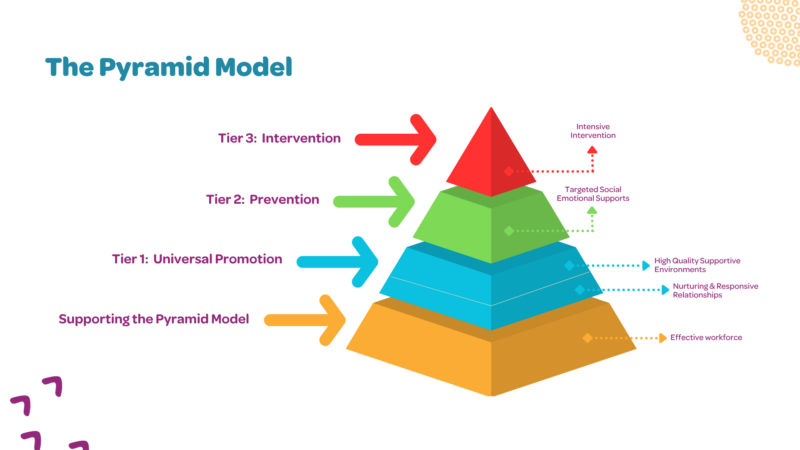
The Pyramid Model is structured across three tiers that work together to create a responsive, inclusive environment for children and educators.
Universal supports form the foundation of emotionally safe, predictable, and inclusive environments. This tier focuses on:
- Relationship‑building that centres trust and attunement
- Sensory‑aware environments that reduce overwhelm and increase regulation
- Visual supports, routines, and transitions that empower children with clarity and autonomy
- Strengths‑based communication that celebrates each child’s unique way of engaging with the world
These universal practices benefit all children, and create the conditions where neurodivergent children can thrive without being asked to mask or suppress who they are.
Tier 2 offers small‑group and individualised strategies for children who benefit from additional scaffolding. These supports are collaborative, affirming, and a bit more personalised than Tier 1 supports. They may include:
- Emotion‑coaching and co‑regulation strategies
- Social‑emotional skill‑building that respects communication differences
- Strength‑based problem‑solving that builds confidence and agency
Tier 2 is not about “fixing” behaviour — it’s about meeting children where they are and giving them tools that feel accessible and empowering.
Tier 3 provides highly individualised, more intensive supports for children with complex needs. This tier is grounded in partnership with families, specialists, and most importantly, the child. It includes:
- Collaborative support planning
- Deeply personalised strategies that honour the child’s communication, sensory, and emotional needs
- Trauma‑informed, neuroaffirming approaches that prioritise safety and dignity
Tier 3 ensures that every child receives support that is respectful, responsive, and rooted in their strengths.
Ready to Transform Your Practice?
Join Us for an Upcoming Pyramid Model Training
Whether you’re looking for an immersive in-person learning experience or the flexibility of online professional development, there’s an option to suit your needs.
In-Person Training
Pyramid Model Foundations Training
📅 Wednesday, 23 July 2026
🕣 8:30am – 4:30pm
📍 Canterbury League Club
Spend a full day exploring the Pyramid Model framework, practical strategies and implementation approaches alongside fellow educators
and professionals committed to inclusion.
Book Now!
Complete your registration below to secure your place.
Online Training – Registrations Open Soon!
Dates:
Fri 31/07 9am – 12.30pm – Tier 1
Fri 07/08 9am – 12.30pm – Tier 2
Fri 14/08 9am – 12.30pm – Tier 3
Online